

How Do I Register My Boat In Kentucky
Beginning October 7, any unpaid boat registration due at the end of September or earlier volition be considered past due. Delight check your county clerk office for consummate data on how to renew your registration.
Top
INTRODUCTION
This publication provides bones information for most boaters and answers the most commonly asked questions. Nevertheless, it is not all inclusive. For further information, please contact the Division of Police Enforcement, #1 Sportsman'south Lane, Frankfort, KY 40601 or call 1-800-858-1549.
For emergencies, officers may be contacted by dialing 1-800-252-5378, or local law enforcement agency or through the nearest Kentucky Country Police post. One may use marine channel xvi to contact a local marina.
Peak
(301 KAR 6:001, 6:010)
All mechanically powered vessels used primarily in this state must have a Kentucky registration. Boats are registered at the county clerk's office. Persons may annals in the county of their residence or the county of principal use. Gunkhole registrations elapse April thirty each year.
Boats registered in other states may be used for up to sixty consecutive days in Kentucky without registering here.
All boats operated in Kentucky must have the registration certificate on board. Boats that are rented from a marina or boat livery must have a lease agreement on lath.
Display OF NUMBER AND DECAL
| Gunkhole REGISTRATION FEES | |||
| Class A Vessels(less than 16' in length) | $21.00 | ||
| Class i Vessels(sixteen' to less than 26' in length) | $40.00 | ||
| Class 2 Vessels(26' to less than 40' in length) | $50.00 | ||
| Course three Vessels(over 40' in length) | $65.00 | ||
| Inboard boats(regardless of size) | $43.00 | ||
| Boats propelled by an electrical (trolling)motor only | $x.00 | ||
| The above costs do non include property taxes, clerks fees, titling fees or any other applicative charges. (301 KAR 6:005) | |||
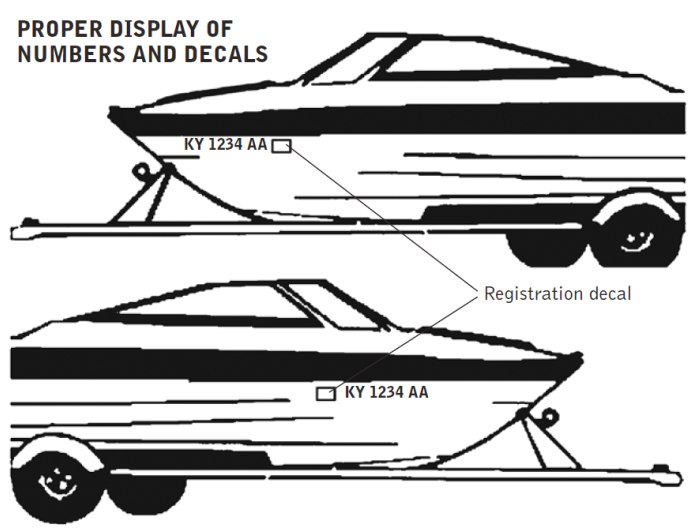
Once boats are assigned a registration number and decals, they must be displayed correctly. The number assigned, and no other, shall be displayed on the bow, or forrard half, of each side of the vessel, read from left to right, and in a position to be distinctly visible. The letters and numbers must be of a plain block design, at least three (three) inches in height, and of a colour that will provide maximum contrast to the background (light numbers on a nighttime hull or vice versa).
There must exist a letter of the alphabet size space between alphabetic character and number groups:
Correct: KY 1234 AA
Incorrect: KY1234AA
Registration decals are to be placed inside six inches backside (aft) and in line with the registration number. Upon renewal every year, former registration decals are to be removed and the current ones applied.
Bordering waters
Kentucky boaters on the Ohio River may as well be subject to the laws of Ohio, Indiana, Illinois and the U.Southward. Declension Guard.
TRANSFER, DESTRUCTION OR ABANDONMENT
When ownership of a currently registered gunkhole changes, information technology is the responsibility of the purchaser to take the endorsed title to the county clerk and have the boat transferred into the proper name of the new owner. This process must be done upon completion of the transaction.
Whenever a vessel is transferred, the seller shall, within 15 days, give the canton clerk notice of the transfer of his interest in the vessel.
Whenever a vessel is destroyed or abased, the owner shall, within 15 days, give notice to the county clerk to terminate the registration. The possessor shall remove the numbers and decals from the vessel.
Top
(301 KAR 1:012, 1:015)
AGE RESTRICTIONS
A person must be 12 years or older to operate a motorboat (including personal watercraft) 10 horsepower or over on Kentucky public waters. A person 12-17 years former shall possess a Kentucky Safety Boating Certificate Card or a certificate showing successful completion of a NASBLA canonical boater pedagogy course. For information about Kentucky'southward Boater Teaching program, call 1-800-858-1549 or click here . Persons under 12 years of age must wear a personal floatation device (lifejacket) while in the open up portion of a boat that is under way.
Maximum horsepower limits and other gunkhole motor and lake usage regulations apply on many small-scale public angling lakes. (For boat size limits see box on this folio.)
MOTOR SIZE RESTRICTIONS:
Operation of electric or internal combustion motors prohibited: Lake Chumley, Dennie Gooch Lake, Kingdom Come up Lake.
Performance of internal combustion motors prohibited: Bert T. Combs Lake, Briggs Lake, Carpenter and Kingfisher lakes, Carter Caves State Park Lake (a.k.a. Smoke Valley Lake), Lebanon Metropolis Lake (a.k.a. Fagan Branch Lake), Fishpond Lake, all Kentucky River WMA Boone Tract lakes (except Benjy Kinman Lake), Lincoln Homestead Land Park Lake, McNeely Lake, Marion County Lake, Martin County Lake, Metcalfe County Lake, Mauzy Lake, Mill Creek Lake, Lake Reba, Spurlington Lake, Washburn Lake, Pikeville Urban center Lake.
Motors larger than 10 HP must operate at idle speed at all times on Beaver Lake, Boltz Lake, Bullock Pen Lake, Corinth Lake, Elmer Davis Lake, Kincaid Lake, Shanty Hollow Lake, Swan Lake, Cranks Creek (Herb Smith) Lake and Martins Fork Lake.
Idle Speed Onl y : Ballard WMA lakes, Benjy Kinman Lake, Boatwright WMA lakes, Beulah Lake, Carnico Lake, Greenbo Lake, Pan Bowl Lake, Wilgreen Lake and all Peabody WMA lakes including Goose, Isle and S.
Lake Malone and Lake Beshear: No horsepower restrictions on boat motors.
Annotation:
Horsepower limits on several lakes changed later on publication of the impress guide. This version reflects the current regulations.
WATER-SKIING
While this section is titled waterskiing, it applies to persons beingness towed on any device such equally articulatio genus boards, inner tubes, etc. Water-skiing is only allowed between sunrise and dusk. Additionally, it is illegal to manipulate skis, surfboards, etc. while intoxicated or under the influence of any other substance that impairs one's operating ability.
Both the operator and skier should exist alert to the areas of a lake or river marked as "no ski." Persons shall non ski inside 100 feet of a commercial boat dock, a moorage harbor or a swimming expanse or within 2,000 anxiety of a lock or dam.
Skiers who ski too close to other boats, docks and obstructions are showing poor judgment. Many of the complaints officers receive while patrolling the water are those about skiers skiing too close.
Persons existence towed on whatsoever device must wearable a Blazon I, Two or 3 PFD. Boats (including personal watercraft) towing skiers must take, in addition to the operator of the boat, an observer 12 years of age or older or a broad angle rearview mirror mounted and then that the operator tin check on the skier but notwithstanding requite full attention to traffic ahead. There must be acceptable seating for all riders.
Boats towing kites and like airborne devices must:
- Take, in improver to the operator, an observer 12 years or older (mirror volition not suffice),
- Stay 500 feet from commercial docks and ramps,
- Limit the tow rope to 150 anxiety or less,
- Have no more than two persons existence towed.
ON ALL KENTUCKY FISH & WILDLIFE-Owned/MANAGED LAKES:
- Boaters must use idle speed (slowest speed possible to maintain maneuverability of a boat) when passing another gunkhole with an occupant actively engaged in fishing.
- The centerline of boats on the water cannot exceed 22 feet as measured on deck or bow to stern on all lakes endemic or managed by Kentucky Fish and Wildlife.
- On Cedar Creek Lake, Lake Beshear and Lake Malone only, float boats may have decking and pontoons up to 30 anxiety; on Guist Creek Lake pontoon max length is 24 feet. There is no size restriction on canoes.
- Houseboats are not permitted.
- Personal watercrafts are prohibited on Cedar Creek Lake.
- Swimming is permitted only in designated areas when a qualified lifeguard is on duty.
- Skin or scuba diving is non permitted.
- Boat motors without underwater exhaust are not permitted.
Water-skiing permitted as designated by signs on Guist Creek Lake and Lake Beshear from ten:00 a.m. to sunset beginning the third Thursday in May (May sixteen, 2019) through September 30. Similarly, h2o-skiing is permitted on Lake Malone beginning the 3rd Thursday in May (May xvi, 2019) through October 31. Water-skiing and tubing are prohibited on Cedar Creek Lake.
PERSONAL WATERCRAFT
The term "personal watercraft" (PWC) ways a vessel which uses an internal combustion engine to power a jet pump for its primary source of propulsion and is designed to be operated by a person sitting, standing or kneeling on the vessel rather than by a person sitting or standing inside the vessel. In add-on to being governed by the same laws that employ to all boats, the following laws use to personal watercraft:
- Personal watercraft can only exist operated between sunrise and dusk.
- Personal watercraft without cocky-circling capability must have a lanyard blazon engine kill switch fastened to the operator when the craft is underway.
- Operators and passengers must article of clothing a U.Southward. Coast Guard-approved personal flotation device (PFD.)
Because of their modest size and low profile, operators of PWCs should practise defensive driving. These craft are highly responsive and capable of quick turns. In fact, this is part of the fun of their operation. However, this kind of operation is reckless if done in congested areas of boat traffic.
Pare AND SCUBA DIVING
(301 KAR 1:410, 6:030)
Skin or SCUBA diving is prohibited in all lakes owned or managed by the Kentucky Department of Fish and Wildlife Resources, except during emergencies, on Gre enbo Lake and during salvage operations when the diver has written permission from the regional director or local wildlife and boating constabulary enforcement officer assigned to the specific body of h2o in which the diving is to take place.
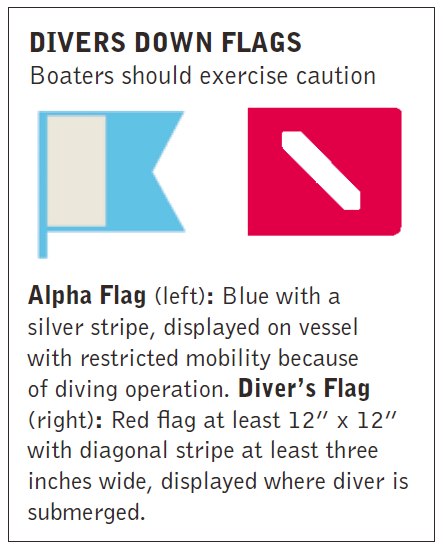
Persons diving or submerging with the aid of a mechanical breathing apparatus in an expanse where boats might be are required by police to display the diver's flag.
This flag should be put on a buoy, boat or other floating platform then boaters volition readily encounter it. Approaching boats must stay outside of a 100-foot radius of the flag. Divers must surface within a fifty-foot radius unless there is an emergency.
Divers shall not dive in established traffic lanes nor interfere with anyone fishing unless emergency operations are in progress.
 SWIMMING
Swimming in any lake endemic or managed by the KDFWR is prohibited except in areas specifically ready aside for swimming at which a qualified lifeguard is on duty. Kentucky law specifically prohibits swimming at any boat launching ramp. Swim in marked and supervised areas. If yous are a non-swimmer or a poor swimmer, wear a PFD. Remember, PFDs are not just for boaters.
Refrain from drinking alcoholic beverages when swimming. Alcohol greatly reduces a person's reflexes and strength when in the water. For persons who have had alcoholic beverages a PFD is the difference between life and death.
Persons who wish to swim a long distance should swim parallel to the shore instead of beyond a river or lake. Boaters don't usually expect to run across swimmers in the middle of a lake or river and may run over them.
INFLATABLES
Air mattresses, inner tubes and other similar devices are more often than not used as recreational items past persons pond or sunbathing. Apply of these items should be restricted to designated or more often than not recognized swimming areas and non be used in areas of boat traffic. Non-swimmers or poor swimmers should not depend on these devices to save their life. These items can be punctured and lose their buoyancy – wear a PFD!
LITTERING
(KRS 433.757)
The operator of any motorboat or vessel is responsible for whatever litter thrown into the h2o. Litter is non just unsightly, but can be dangerous to humans and animals. For example, fishing line discarded into the water tin can be hazardous to wild fauna and to a boat's lower unit of measurement. Animals can exist ensnared in the line and dice. Fishing line defenseless on a prop shaft tin cause seal leaks and lower unit failure. Trot lines and limb lines can snare animals and other anglers in boats.
Top
RECKLESS Functioning
The operator of a watercraft is responsible for damage caused by negligent operation. The following actions are considered reckless operation and are therefore against the law:
- weaving through traffic;
- post-obit watercraft too closely that is towing an individual on waterskis, a surfboard or whatsoever water sport device;
- jumping the wake of some other craft in a style that endangers human life, physical safety or property;
- cutting between a boat and the individual(south) being towed past the boat;
- crossing the path of another boat when visibility is obstructed;
- steering toward an object or individual in the water and turning sharply at close range.
Persons shall not operate a motorboat or personal watercraft inside 50 feet of a commercial vessel and its tow that is in operation on a waterway, except if the operator of the commercial vessel has given consent.
When operating in a busy expanse, reduce speed and allow plenty of room for avoidance maneuvers. Even in areas that are not marked as idle speed, excessive wake can nonetheless be unsafe. Operators of larger craft should be enlightened of the wake their vessels are throwing.
IDLE SPEED
Kentucky law defines idle speed every bit the "slowest speed possible to maintain maneuverability" of a boat. Mostly speaking for a properly adjusted gunkhole, this is the speed when a boat is put into gear without advancing the throttle. Wakes can capsize pocket-size boats or cause damage to boats moored at marinas and docks. Information technology is extremely of import that gunkhole operators be aware of their speed and the resulting wake. Operators are liable for any injuries or harm caused past their boat's wake.
Boaters may see buoys or signs that say "No Wake." This means that boats must exist at idle speed.
LOCKS AND DAMS
Boaters in Kentucky may encounter lock and dam systems. Generally, these will exist on the Green, Ohio and Kentucky Rivers (for the beginning four locks upstream to Frankfort, KY), but a few impoundments have a lock and dam. Locks are a relatively uncomplicated method of raising or lowering boats from one water level to another. If lockage is desired, boaters should signal the lock operator past using the pull chain on each end of the lock or call on marine channel 13. If the lock is non immediately available, boaters should position their vessels a safe distance from the approach channel to avoid personal injury or damage to their boat from wakes caused by commercial tows entering or leaving the locks. Never moor a vessel in the lock approach channels.
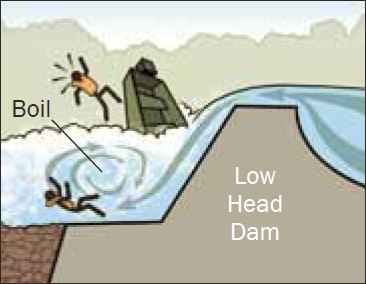
Low HEAD DAMS ARE DANGEROUS
Low head dams are usually marked with "go on out" buoys or "danger" signs above and below. Low head dams pose an even greater danger due to the fact that they are not as recognizable, especially when h2o is flowing over them. It is this catamenia of water over the dam that creates a "boil" on the lower side. Boaters risk almost certain death if caught in this turbulence.
Dams associated with the locks can be very unsafe. Below locks and dams on U.S. Army Corps of Engineers waterways and the Kentucky River, boat occupants must article of clothing a personal floatation device (lifejacket) upstream of danger signs and open up-diamond buoys or within 150 feet of the downstream lock and dam wall. Anglers should never fish from or stand on lock and dam structures.
Boaters should be warning for these structures. Dams are either conventional or "low caput" blazon. Conventional dams are easily recognizable with their spillways and power installations.
RESTRICTED ZONES
(KAR 6:030)
Kentucky law prohibits boats from operating inside restricted areas as posted in a higher place or below navigation, power generating or alluvion control dams.
No fish is worth risking your life. Exist aware of trespassing and danger zones. Vesture a PFD when entering any surface area above or beneath a dam.
OPERATING Under THE INFLUENCE
(KRS 235.240)
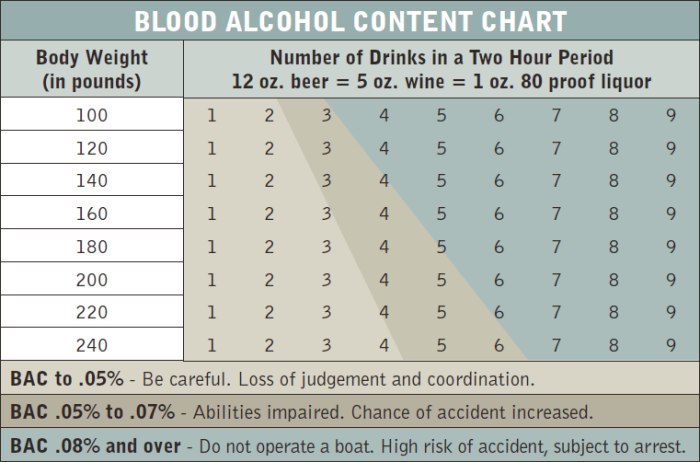
Information technology is against the law to operate a boat or vessel including personal watercraft, manipulate h2o skis, surfboard or other similar device while intoxicated or under the influence of any other substance that impairs ane'due south driving power. Any person who operates a vessel on Kentucky waters is considered to have given consent to a test or tests to determine his alcohol concentration or the presence of other drugs. The tests shall be administered at the direction of a constabulary enforcement officeholder who has probable cause to believe that the operator is intoxicated. An operator refusing the test shall be in violation of the law and subject to the aforementioned penalties.
Anyone who operates a gunkhole, PWC, skis, surfboard or similar device while intoxicated with a blood alcohol level of 0.08 or higher or while nether the influence of any substance that impairs the operator's driving ability may be bailiwick to fines and possible jail time if convicted.
SMALL CRAFT PRECAUTIONS
Statistics bear witness that approximately half the gunkhole-related fatalities involve boats that are less than 16' in length. These boats are usually unstable and tin can tip over, throwing the occupants overboard. Also, these boats tin be easily swamped, especially if used on a large trunk of water where the wind tin can cause high waves. When using such craft, be aware of the hazards. Wearing a personal floatation device (PFD) is strongly recommended.
DRINKING IN PUBLIC AND PUBLIC INTOXICATION
(KRS 222.202)
Kentucky law specifically prohibits the drinking of alcoholic beverages in public places (this excludes establishments licensed to sell such beverages) and the waterways of this state are considered public places.
Further, in a public identify, persons who are patently nether the influence of alcoholic beverages to the extent that they may unreasonably annoy or endanger themselves or others shall be subject to arrest.
PROHIBITED RIDING
Approximately half of boat related fatalities result from falls overboard. When operating a motorboat above idle speed the operator or passengers shall not ride on an enclosed bow, outside protective railing of a pontoon or houseboat, on a seat which extends six inches in a higher place the plane of the gunwales, nor shall they ride on the sides, back, engine encompass, back of seat, or any other apparently dangerous position which could lead to falling overboard.
Acme
Boats Keep Out!
Nature of danger may exist placed outside crossed diamond, e.g., waterfalls, swim areas or rapids.
Danger!
Nature of danger may exist indicated inside the diamond shape, e.yard., rocks, reefs, dams, construction or snags.
Caution!
Controlled Areas as indicated in circle, due east.g., speed limit, no fishing, no anchoring, ski-only, slow-no wake, no ski or no prop boats.
Information
Tells directions, distances, places such as food, repair, supplies and other not-regulatory messages.

Obstacle
Marking Do non pass between shore and buoy.
Mooring Buoy
White with reflective bluish ring. May take white light or reflector.
Channel Marker
 Proceed buoy on right facing upstream.
Channel Mark
Continue buoy on left facing upstream. Marker may exist green or blackness.
Boaters on the h2o encounter three situations: meeting, crossing and overtaking. The following diagrams should give a articulate explanation of who has the right of way (stand-on vessel) and who must give fashion (give-manner vessel). However, in an emergency, all vessels must requite mode to avert a collision. At night, a boat's navigation lights give an indication of right of manner.On the water there are no painted lines to mark where boats must go. In order to provide an orderly flow of traffic, in that location are "rules of the road" that boaters should learn and exercise.
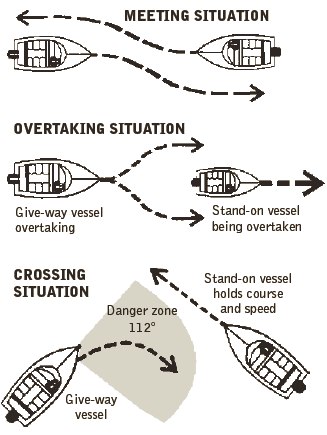
The above rules cover almost traffic situations, merely a few other situations exist. Sailboats under sail have the right of way except when they are the overtaking vessel. Rowboats and paddle powered boats have the correct of manner over motorboats. All recreational craft should yield the right of way to large commercial craft (towboats, barges). Such vessels have big blind spots and will be unable to see smaller crafts in front end of them.
On modest or narrow bodies of water, all traffic should stay to the right of mid-channel and not "cut corners".
BUOYS
Buoys are the most common types of navigational aid, and they serve the same purpose as traffic signs on the highway. Failure to obey buoys can consequence in enforcement activeness, or worse, a loss of property or lives. When boating in unfamiliar waters, slow down and look for any regulatory or channel-marker buoys. Remember that it is possible for these buoys to drift out of position. Kentucky law prohibits from tying up to any buoy except designated mooring buoys.
Acme
(301 KAR 6:040 Sect. iv)
For each person onboard a vessel, federal equally well as state law requires a Blazon I, Two, or III personal flotation device (PFD) on all boats. Boats 16 feet and over, except canoes and kayaks, must also carry ane Type Iv throwable PFD. Operators and passengers of personal watercraft must wear a PFD. Persons under 12 years of age must habiliment a PFD while in the open up part of a boat that is under fashion.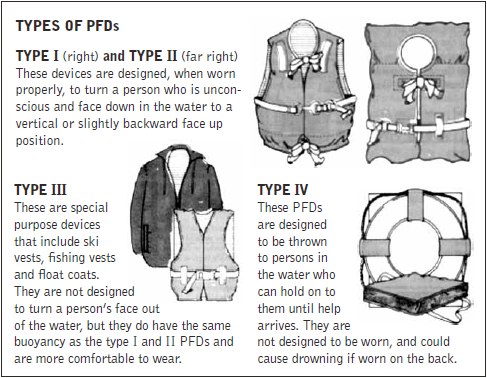
PERSONAL FLOTATION DEVICES
Kentucky Fish and Wildlife strongly recommends wearing PFDs while boating, especially past children and non-swimmers. In gild for PFDs to exist legal, the following requirements must be met:
- Coast Guard approved: A label with an approval number volition be on the PFD. Check the label on inflatable types of PFDs. Some older models come across Coast Guard approval just when worn.
- Serviceability: All straps, buckles, zippers, stitching, must be intact and the fabric should not exist rotted. Some PFDs contain closed numberless filled with a fibrous material. Squeeze the bags. If air escapes, destroy the PFD and supervene upon it with a new one.
- Size: PFDs must fit properly. Read the characterization to determine size and weight restrictions.
- Accessibility: PFDs must be readily available for immediate utilise by all occupants of a vessel. It is advisable for each person to endeavor on their PFD before parting and then that they are familiar with the fastening devices and to assure it is adjusted to the person. PFDs shouldn't exist stored in the plastic bags in which they were sold. This limits access and tin can promote rotting.
Burn down EXTINGUISHERS
Kentucky police force requires that all boats equipped with a petroleum product (gasoline, kerosene, propane, etc.) consuming device (engines, lanterns, stoves, etc.) shall have a hand portable burn down extinguisher in serviceable condition and located for immediate utilize. The best fire protection is well maintained equipment and proper prophylactic habits.
There are fuels other than gasoline that cause fires. Many houseboats use bottled gas (propane) for stoves and other appliances. Also, many fishermen will apply a lantern while fishing at night; if tipped over it can crusade a fire.
| MARINE FIRE EXTINGUISHER CLASSIFICATION | ||||
| Coast Baby-sit Classes | UL Listing | Cream (gals.) | CO2 (lbs.) | Dry Chemical (lbs.) |
| B-I | 5B | 1.25 | four | two |
| B-2 | 6B* | 2.v | 15 | 10 |
| - | 10B | none | ten | two.5 |
| - | 20B | 2.v | 50 | iv.5-six |
| MINIMUM NUMBER OF B-1 FIRE EXTINGUISHERS | ||
| Vessel/size | No Stock-still Fire Extinguisher System | Fixed Fire Extinguisher System Installed |
| Class A | i | 0 |
| Form 1 | 1 | 0 |
| Class 2 | 2 | 1 |
| Grade iii | 3 | 2 |
BACKFIRE FLAME ARRESTERS
Internal combustion engines may backlash. To safeguard against burn down, all motorboats with enclosed engines and engines originally equipped with a flame arrester, (except outboards and diesels) must have an approved carburetor backfire flame arrester system on each carburetor.
VENTILATION
Most fires on a boat are due to ignition of fuel vapors. Gasoline is heavier than air. It can collect in the bilge or engine compartment and any spark tin can ignite information technology. Therefore, Kentucky law requires boats to have adequate ventilation of areas where flammable vapors can accumulate.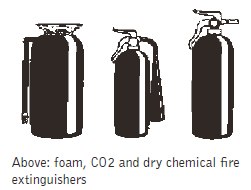
Well-nigh boats are equipped with acceptable ventilation systems when they come from the mill. Usually, this is a combination of agile and passive systems. Active systems utilise electrical blowers to exhaust combustible vapors from the bilge and other areas. Passive systems are ducts and cowls that ventilate areas when the boat is moving. Almost all inboards volition have an electrical blower installed in the engine compartment. Operators should run the blower for several minutes before starting the engine. If the blower is inoperable information technology should exist repaired or replaced immediately. Many boat fires take place after refueling, so care should be taken to avert spilling fuel in the vessel.
NAVIGATION LIGHTS
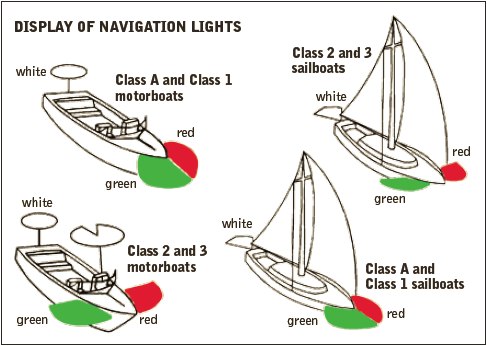
All vessels when underway betwixt dusk and sunrise must brandish proper navigation lights. Navigation lights on boats are restricted to the colors of ruddy, greenish and white.
From sunset to sunrise in an area where other boats navigate, all vessels at anchor shall display a steady white light visible 360 degrees at all times. Manually propelled vessels shall carry a white light to display in sufficient time to avert a collision.
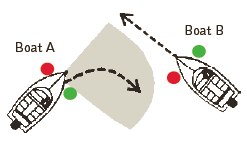
The purpose of the red and green navigation lights at dark is to show if your boat is in a meeting, crossing or overtaking situation. The red and green lights must be displayed from sunset to sunrise whenever a boat is underway. They volition give some indication of the size and speed of vessels. The red and light-green bow lights are especially helpful in determining right of way in crossing situations. In the diagram below, boat B sees the green bow light of boat A, and has the right of way to go on on class. Boat A sees the cherry-red bow light of boat B and must finish or pass astern of boat B. In special circumstances, such as towing, refer to 33 CFR 83 (Inland Navigation Rules).
SIGNALING DEVICES
Kentucky police states that all boats sixteen feet in length or longer must have a hand-, rima oris- or power-operated signaling device capable of producing a blast for 2 seconds or more than and aural for i-half mile for form 1 vessels, one mile for form two vessels and one and one-one-half miles for class three vessels. This does not exempt vessels from whatsoever other signaling device every bit may be required by federal law when operating on navigable waters of this land.
Navigation law besides requires the following maneuvering and warning signals:
- One long blast: Alert signal (coming out of slip)
- I brusk boom: Laissez passer on my port side (left)
- Two short blasts: Pass on my starboard (right)
- Iii short blasts: Engines in reverse
- V or more blasts: Danger signal
MUFFLING DEVICES
Kentucky law requires all boats to be equipped with effective exhaust muffling devices. Usually, boats and motors that come direct from the manufacturer are adequately muffled. Even so, there may be instances of high performance boats that have been modified by the owners that are not in compliance with the law. Additionally, at that place may be federal and/or local regulations restricting boats with an over-the-transom exhaust system.
MARINE SANITATION DEVICES
(KRS 235:420)
Motorboats with marine toilets are non allowed on public waters unless the toilet is equipped with a Type I, II or 3 marine sanitation device (MSD.) Type I and Ii MSDs chemically care for sewage. Blazon III MSDs are holding tanks for raw sewage.
Raw sewage shall non be discharged in any public waters. Treated sewage may be discharged from a marine toilet into legal "discharge" waters. Those waters are Barkley and Kentucky lakes, Lake Cumberland and any of the major river systems. Type I and II MSDs must exist sealed or locked while the vessel is on "no discharge" waters.
Top
(301 KAR 6:030, KRS 235.250)
REPORTING REQUIREMENTS
If any of the following weather condition occur as the result of a boating accident, collision, etc., a Boating Accident Report must be fabricated:
- death or disappearance of a person;
- injury to a person which requires medical attention or incapacitates that person for 24 hours or more than;
- loss or damage to property (including the vessel) in an amount of $500 or more.
The operator of a vessel is required to complete the written report. If the operator is not capable of filing the report and is non the possessor of the vessel, then the owner shall exist required to fill out a canoeing accident written report.
Notation 1: Even if a Law Enforcement Officer fills out a canoeing accident report, this does not exempt the operator from filing a report.
Annotation two: The reports filed by operators of vessels are confidential and are not available equally public record (KRS 235.250). Even so, reports made by officers are available for review.
Accidents involving death or serious injury must be submitted to the Sectionalisation of Law Enforcement inside 48 hours. All others must be submitted within five days.
Boating accident report forms are available from wildlife and boating police force enforcement officers or past writing to Kentucky Department of Fish and Wildlife Resources, Division of Police Enforcement, #1 Sportsman'southward Lane, Frankfort, KY 40601, by calling 1-800-858-1549 or online.
RENDERING Assistance
An operator of a vessel involved in a canoeing accident shall return aid to other persons and vessels as long as it doesn't endanger his coiffure, passengers or vessel. Also, the operator of whatever vessel involved in an accident shall give his name, address, and identification of his vessel, in writing, to any person that is injured or to the owner of any holding that is damaged.
Offset Assist
This department includes suggestions that may save a life. First, boats should exist equipped with a first help kit. This kit should be able to provide handling for burns, insect bites, cuts and abrasions.
2d, boaters should accept a first assistance form so they know how to treat victims with sprains, broken bones and shock.
Tertiary, boaters should know how to perform Cardiopulmonary Resuscitation (CPR) in case they encounter victims of near drowning, heart attack or trauma from boating accidents. In many cases, emergency medical aid is farther away on the water than on state. Interested persons should contact their local affiliate of the American Reddish Cross for information on first assist and CPR training.
HYPOTHERMIA
Four elements cause hypothermia – common cold, wet, current of air and exhaustion. Symptoms of hypothermia are uncontrollable shivering, slurred speech, stumbling, blue skin, decreased heart and animate rate, weak pulse and unconsciousness.
All hypothermia symptoms demand immediate attending. As before long every bit possible, a victim of hypothermia should be brought out of the weather condition. Wet clothing should be replaced with dry out clothing. If the victim shows mild symptoms, become them near a fire or other estrus source or put them in a warm sleeping bag. For victims with advanced symptoms of hypothermia, seek immediate medical attention. Never give alcohol to the victim.
The best cure for hypothermia is prevention. Monitor atmospheric condition reports when you plan to be in the outdoors. Apparel in layers and always have foul-weather gear handy.
FATIGUE
Boaters should exist aware of the factors that induce fatigue while on the water. The current of air, lord's day, engine noise and constant movement of the boat can greatly reduce a person's reaction fourth dimension.


Source: https://fw.ky.gov/FishBoatGuide/Pages/Boating.aspx
Posted by: griggsofut1941.blogspot.com
0 Response to "How Do I Register My Boat In Kentucky"
Post a Comment